
Module 5: Going Live, lesson 5.1
Million Dollar Ad Structure
9 steps20:17 long11 rules
This lesson introduces the foundational testing framework and ad structures used by top affiliates. It explains how to manage ad variance by analyzing data averages and testing variables systematically. The coach reveals the 'Catalog Method' to drastically reduce ad rejections and the 'Duped Ad Sets' campaign structure for scaling. Finally, it provides strict naming conventions and a hierarchy for testing creatives, ad accounts, and offers.
Campaign structureThe recommended campaign structure is the 'Duped Ad Sets Campaign' using ABO. It uses a 1-X-1 structure (1 campaign, X ad sets, 1 ad per ad set) where every ad set contains the exact same ad. The suggested setup is 1-25-1 (25 ad sets) with a minimum budget of $1 per ad set, totaling $25 per campaign per ad. If budget allows, this can be scaled to 1-50-1 ($50 per campaign). The maximum limit is 250 ad sets per campaign. Because only one ad is tested per campaign, all data analysis and decisions (CPC, CPA, cost per checkout) are made at the campaign level rather than the ad set level.
Catalogue methodThe 'Secret Catalog Method' is used to prevent Facebook from rejecting over 90% of ads, allowing for highly aggressive copy and visuals (within legal limits). It works by showing Facebook a 'white hat' or clean image that has nothing to do with the offer, which bypasses the review filters. While it prevents rejections, it can result in a 5-10% loss of traffic because Facebook may occasionally spend budget on the clean image instead of the actual ad creative. Despite this, it is highly recommended because the aggressive marketing it enables converts much higher than the traffic lost.
Rules and numbers
- Look at averages for at least 2 or 3 days of results to get to conclusions, rather than just one day performance.
- Use a 1-X-1 structure with the same ad per campaign, meaning 1 campaign, multiple ad sets, and 1 ad per ad set.
- Set a minimum budget at the ad set level, typically $1 if your account is in USD.
- Make decisions at the campaign level, even if using ABO, because you are only testing one ad per campaign.
- Suggested structure is 1-25-1 ($25 per campaign) per ad created, or 1-50-1 ($50 per campaign) if you have more budget.
- Campaign naming convention: Account Name - Campaign Type (e.g. ABO 1-25-1) - Page Name - Creative Name.
- Ad and Ad Set naming convention: HookName/AvatarName/AngleName/CopyName.
- Test videos in the beginning, not images, because video is the main creative type working right now.
- After testing 10 to 20 brand new creatives, you can test a new ad account with your top 1 or 2 creatives.
- If you don't get results after testing over 10 brand new creatives and 3 different ad accounts, test a different offer.
- Limit duped ad sets to 250 per campaign due to logistical limits.
Gotchas
- If you run exactly the same three ads for the same offer in two different ad accounts, one is going to perform better than the other due to ad variance.
- Weekends typically sell more and have higher ROI than weekdays due to regular human behavior.
- The Catalog Method loses 5-10% of traffic because Facebook might spend a little bit on the white hat image instead of the offer.
- The duped ad sets structure takes more work, budget is more volatile, and it can sometimes take up to 48 hours to start spending.
- If your ad account has a spending limit (e.g., $50), you have to spend a little bit first so it starts spending more.
- If you are having a very bad day in the middle of the day, you can pause the ads and relaunch for the next day; you don't need to let them run forever.
“A/B test is king in marketing, being able to test variable by variable each at its own time.”
“Data will be a better coach than me. My job as your mentor is just to teach you how to read data, make decisions on it, iterate on them.”
“It prevents Facebook from rejecting over 90% of your ads... you can just be very aggressive in the copy and in the visuals.”
“The more clarity you have on what you're testing next, the better, because then you're going to be able to visually see what's working.”
Step 100:00 to 01:44
Review the module overview on the 'What you're going to learn in this video' slide
- The importance of testing every ad variable, from the creative to your Facebook assets
- The secret "Catalog Method" to decrease rejections
- The "Duped Ad Sets Campaign" Technique
- Tracking Naming Conventions for Pro Level Organization
To outline the advanced strategies and organization techniques used by top affiliates.
Step 201:44 to 03:36
Review the testing framework principles on the 'The Testing Framework' slide
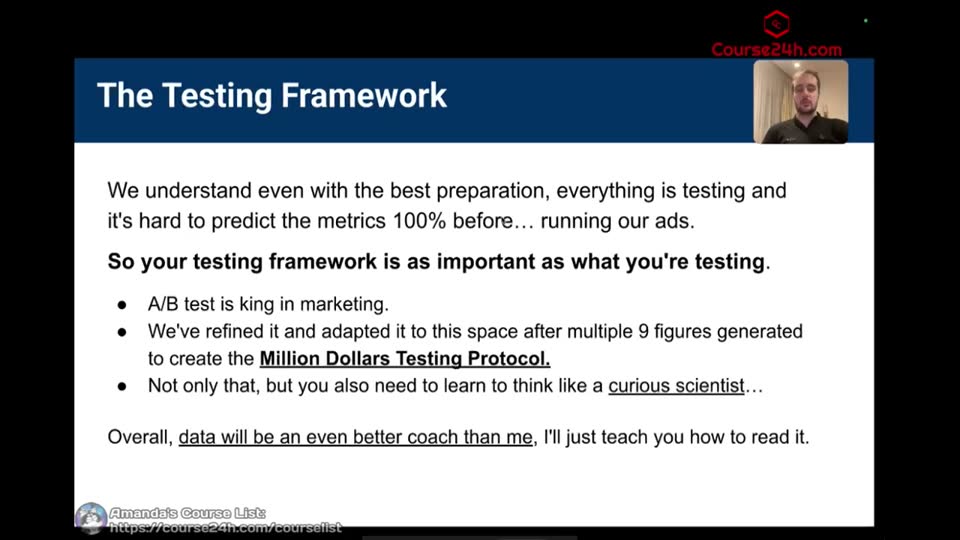
- We understand even with the best preparation, everything is testing and it's hard to predict the metrics 100% before... running our ads.
- So your testing framework is as important as what you're testing.
- A/B test is king in marketing.
- We've refined it and adapted it to this space after multiple 9 figures generated to create the Million Dollars Testing Protocol.
- Not only that, but you also need to learn to think like a curious scientist...
- Overall, data will be an even better coach than me, I'll just teach you how to read it.
To emphasize that data dictates decisions and testing frameworks are as important as the variables themselves.
Step 303:36 to 08:12
Understand the causes of performance fluctuations on the 'Understanding Ad Variance' slide
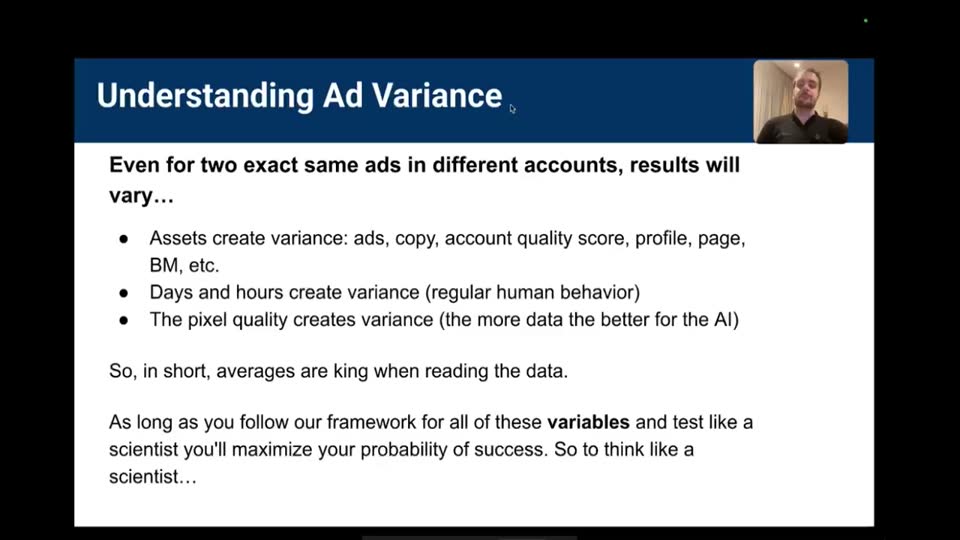
- Even for two exact same ads in different accounts, results will vary...
- Assets create variance: ads, copy, account quality score, profile, page, BM, etc.
- Days and hours create variance (regular human behavior)
- The pixel quality creates variance (the more data the better for the AI)
- So, in short, averages are king when reading the data.
- As long as you follow our framework for all of these variables and test like a scientist you'll maximize your probability of success. So to think like a scientist...
To prevent frustration when results change daily and to teach the importance of looking at multi-day averages.
Step 408:12 to 10:30
Learn the rejection-proof strategy on the 'The Secret "Catalog Method"' slide
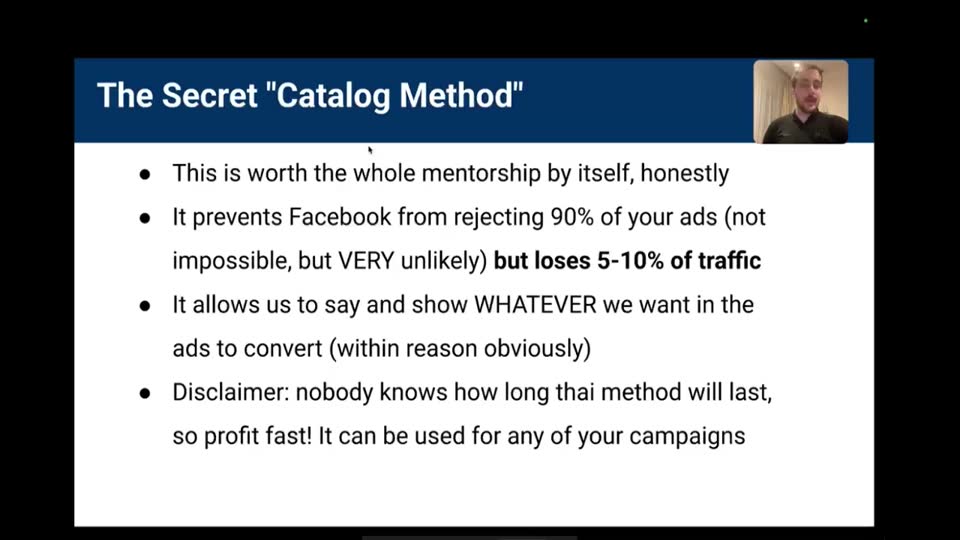
- This is worth the whole mentorship by itself, honestly
- It prevents Facebook from rejecting 90% of your ads (not impossible, but VERY unlikely) but loses 5-10% of traffic
- It allows us to say and show WHATEVER we want in the ads to convert (within reason obviously)
- Disclaimer: nobody knows how long thai method will last, so profit fast! It can be used for any of your campaigns
To allow aggressive marketing copy and visuals without getting accounts banned.
Step 510:30 to 12:10
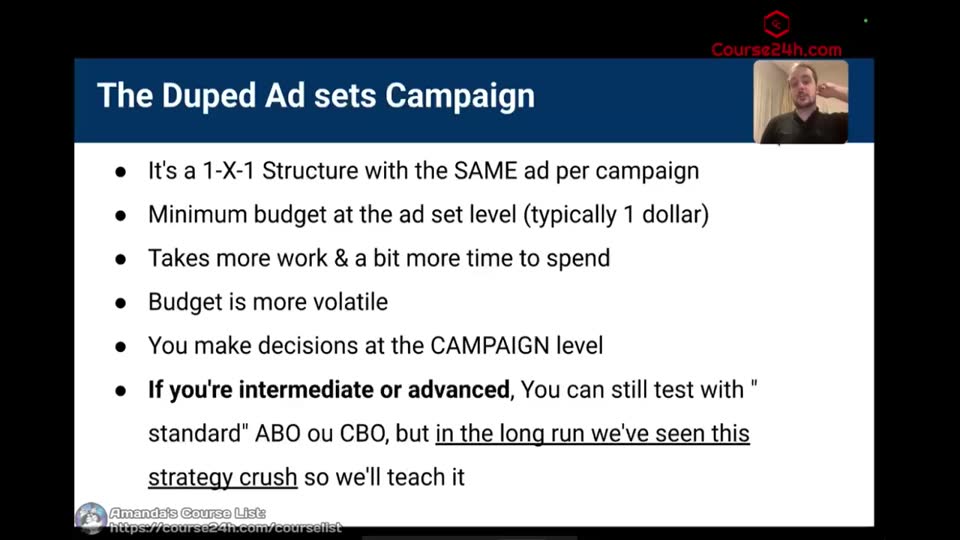
Review the campaign setup rules on the 'The Duped Ad sets Campaign' slide
- It's a 1-X-1 Structure with the SAME ad per campaign
- Minimum budget at the ad set level (typically 1 dollar)
- Takes more work & a bit more time to spend
- Budget is more volatile
- You make decisions at the CAMPAIGN level
- If you're intermediate or advanced, You can still test with "standard" ABO or CBO, but in the long run we've seen this strategy crush so we'll teach it
To introduce a highly effective, long-term scaling structure used by underground affiliates.
Step 612:10 to 13:08
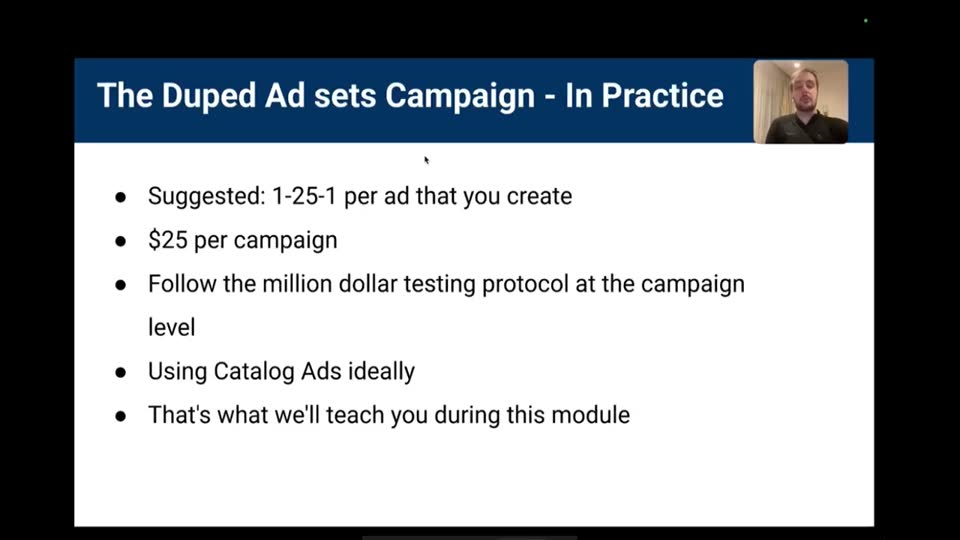
Examine the practical application on the 'The Duped Ad sets Campaign - In Practice' slide
- Suggested: 1-25-1 per ad that you create
- $25 per campaign
- Follow the million dollar testing protocol at the campaign level
- Using Catalog Ads ideally
- That's what we'll teach you during this module
To provide exact budget and duplication numbers for launching the first campaigns.
Step 713:08 to 16:02
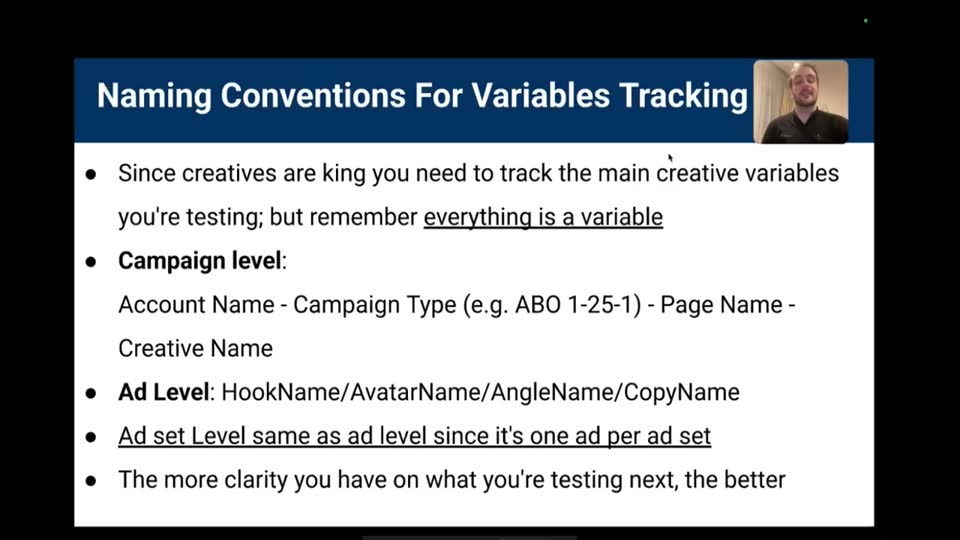
Learn the tracking syntax on the 'Naming Conventions For Variables Tracking' slide
- Since creatives are king you need to track the main creative variables you're testing; but remember everything is a variable
- Campaign level: Account Name - Campaign Type (e.g. ABO 1-25-1) - Page Name - Creative Name
- Ad Level: HookName/AvatarName/AngleName/CopyName
- Ad set Level same as ad level since it's one ad per ad set
- The more clarity you have on what you're testing next, the better
To ensure visual clarity on what variables are working when analyzing data.
Step 816:02 to 18:26
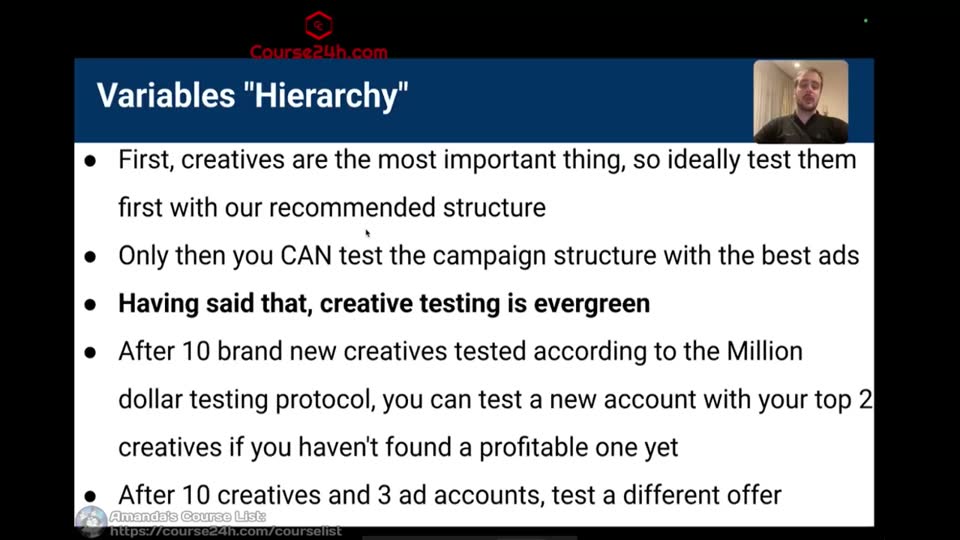
Review the testing order on the 'Variables "Hierarchy"' slide
- First, creatives are the most important thing, so ideally test them first with our recommended structure
- Only then you CAN test the campaign structure with the best ads
- Having said that, creative testing is evergreen
- After 10 brand new creatives tested according to the Million dollar testing protocol, you can test a new account with your top 2 creatives if you haven't found a profitable one yet
- After 10 creatives and 3 ad accounts, test a different offer
To prioritize creative testing before moving on to structural or account-level variables.
Step 918:26 to 20:20
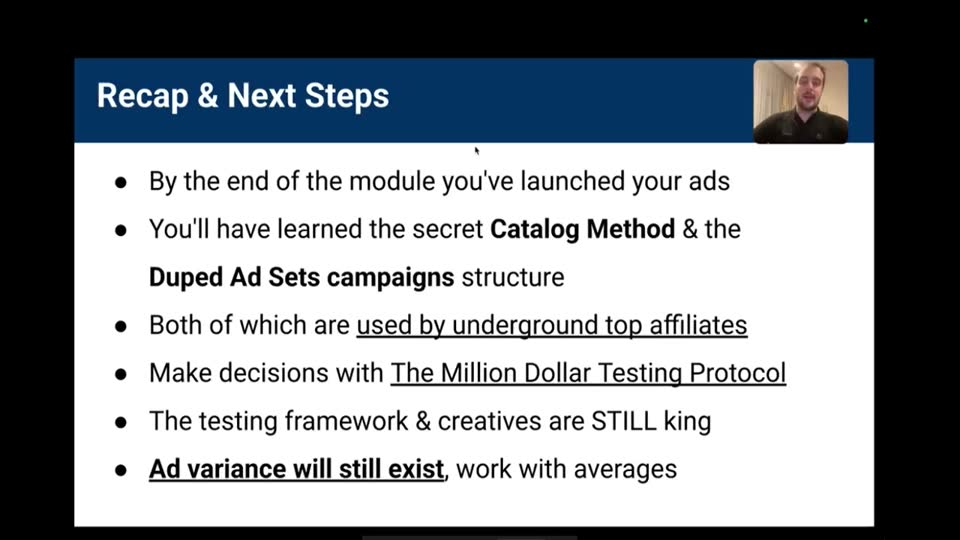
Review the summary on the 'Recap & Next Steps' slide
- By the end of the module you've launched your ads
- You'll have learned the secret Catalog Method & the Duped Ad Sets campaigns structure
- Both of which are used by underground top affiliates
- Make decisions with The Million Dollar Testing Protocol
- The testing framework & creatives are STILL king
- Ad variance will still exist, work with averages
To summarize the core concepts before moving to practical implementation.
Full timestamped transcript with on-screen notes
[00:00]
[SCREEN 00:00] Slide: Module 5: Your Million Dollar Ad Structure & Techniques
[00:00] COACH: Hey guys, so welcome to module 5 where we're going to talk about your million dollar ad structure and the techniques you need to be a top affiliate here. So this is very, very exciting, a very important module obviously. So here's what you're going to learn in this video.

[00:10]
[SCREEN 00:10] Slide: What you're going to learn in this video
- The importance of testing every ad variable, from the creative to your Facebook assets
- The secret "Catalog Method" to decrease rejections
- The "Duped Ad Sets Campaign" Technique
- Tracking Naming Conventions for Pro Level Organization
[00:12] COACH: The importance of testing every ad variable, from the creative to your Facebook assets, everything needs to be tested. Obviously creative is king, so the better creatives you can make, that's the easiest principle in this whole training, the better results you're going to have. Having said that, you also need to test every single asset on Facebook and it's my job to teach you how to be a top affiliate. And as a top affiliate, you need to be testing also your ad accounts, your BMs, different pages, different ad structures, different bids. We're going to talk about all this advanced stuff. And among the advanced stuff, two strategies we're going to teach you already in this module, absolutely insane, really, really good and honestly used by underground affiliates. The first, the secret catalog method to decrease ad rejections. Still not impossible to get ads rejected, but very, very unlikely. So you can pretty much go as aggressive as you want in terms of copy and visual, obviously within reason, but you can still do it. So this method is going to be absolutely amazing. I hope you guys are hyped about it because it's worth the full training by itself, to be very, very honest. And you can obviously use it for any campaigns that you might run during this training or after. The duped ad sets campaign technique, also super underground, high level technique for affiliates. You guys are going to see what I mean by that. And tracking naming conventions for pro level organization. So how to organize all that like a pro, like I've seen in the absolute best agencies, like I do in my own agency, and like I've seen for multi eight and nine figure agencies as well, because I worked with all of them. So I can tell you guys how they work as well and how top, top affiliates work as well with the naming conventions.

[01:44]
[SCREEN 01:44] Slide: The Testing Framework
We understand even with the best preparation, everything is testing and it's hard to predict the metrics 100% before... running our ads.
So your testing framework is as important as what you're testing.
- A/B test is king in marketing.
- We've refined it and adapted it to this space after multiple 9 figures generated to create the Million Dollars Testing Protocol.
- Not only that, but you also need to learn to think like a curious scientist...
Overall, data will be an even better coach than me, I'll just teach you how to read it.
[01:49] COACH: So first, the testing framework. So very, very important obviously, because even with the best preparation, everything is testing. Especially when it comes to ads, it's very hard to predict the metrics 100% before you actually run your ads. For example, if you run exactly the same three ads for the same offer, same ad structure, same everything in two different ad accounts, one is going to perform better than the other, always. So performance is always going to be different. So your testing framework is as important as what you are testing. So obviously having better ads is super, super important, is the 80/20, but how you test all these variables is as important as having the best ad accounts, as having the best creatives, the best ad structure and all that fun stuff. Now obviously for a lot of these things, you already have it, right? So for example, you have the best offers in the market because we already tested them for you and we're always going to be refreshing them. You have models of winning ads, but you need to be able to create your own ads, you need to be able to test your own ad sets, assets, and that's what I'm going to be teaching you. So A/B test is king in marketing, being able to test variable by variable each at the same time, sorry, each at its own time. And we refined and adapted this method in this space specifically after multiple nine figures generated to create the million dollars testing protocol. And not only that, but you need to learn to think and to test each of these variables like a scientist, because honestly guys, data will be a better coach than me. My job as your mentor is just to teach you how to read data, make decisions on it, iterate on them, test every variable, make experiments, and then with the conclusions of these experiments, rinse and repeat. Keep doing tests, keep reading the data, understanding what it tells you, and then eventually being able to make even better decisions.

[03:36]
[SCREEN 03:36] Slide: Understanding Ad Variance
Even for two exact same ads in different accounts, results will vary...
- Assets create variance: ads, copy, account quality score, profile, page, BM, etc.
- Days and hours create variance (regular human behavior)
- The pixel quality creates variance (the more data the better for the AI)
So, in short, averages are king when reading the data.
As long as you follow our framework for all of these variables and test like a scientist you'll maximize your probability of success. So to think like a scientist...
[03:37] COACH: Before that, one very important thing, you need to understand ad variance. A lot of people, especially beginners, but honestly even intermediates and advanced people too, they get frustrated because of ad variance. So seeing results change dramatically sometimes day after day, week after week, even across ad accounts, across ads. And this is completely normal and there are many reasons why this happens. The first reason why this happens is the assets. So obviously having different ads, having different pieces of copy. Even the different ad accounts, guys, I already talked about this, but if you test the same ad, same offer in three different ad accounts, five different ad accounts, results are always going to be different, right? Obviously the same for different ads, for different anything. The only fixed variable is going to be having the best offers because this is on us. But all the rest is going to be on you. So actually testing the ads based on the winning models that we already gave you. Days and hours also create variance. And this is just regular human behavior and you need to understand this just to give you guys a benchmark. This is going to be an important benchmark and pattern for you guys to know. Typically on the weekends it just sells more. ROI is higher on weekends. Probably because people are just chilling in their homes and they are actually in the mood of buying these supplements more, right? Maybe that's it. But it's just a fact. On weekends it's just much better typically. I don't know why. Sometimes I don't have a very, very clear pattern during the weekdays, so I can't tell you if Monday is better than Tuesday, that's better than Wednesday. I really can't tell you that. I can tell you that typically weekends are better overall than weekdays. So some people just test on the weekends, which I don't necessarily recommend obviously, because it's just going to take a long, long time to test. But it's something that some people do when their cash is very limited to test, for example. Not an official recommendation, but just to show you that even the days and the hours that you're going to be running your ads create variance. So especially, and you're going to see this throughout the module, but day after day, if you're having a very bad day, sometimes in the middle of the day, I just pause the ads because it's not working, right? Because I know that's going to be a bad day and I can just relaunch it for the next day. And maybe if you're intermediate and you already know a little bit about ads, maybe you would be scared that you're not letting the campaigns run forever to let Facebook optimize. You don't need to. With the structures that we're going to show you, you don't need to be letting them running for multiple days until they necessarily learn too much about your data. Because typically the pixel quality creates variance. So the more data, the better for the AI to give you better data. We talked a little bit about the pixel as well, but it's pretty much it, literally. The more purchases you get into your pixel, so the more purchases you're getting, it sends this to Facebook and Facebook is better to give you even more purchases because now it knows more about who's going to purchase from you, right? And from your specific ads and your specific ad account. However, with the ad structures that we have, you don't have to think too much about this in terms of ad variance, just because you can just pause for a given day if it's not getting results. You can do a day by day analysis, but you still need to be doing averages, right? You need to be looking at averages because averages are king when you're reading your data. So that's very important. Because obviously maybe one day is going to be better than the other one. One ad is going to crush one day, then get destroyed for the next 24 hours and then crush the third day, for example. I'm just giving random examples obviously. But that's why we look at the averages. We don't look at just one day performance. We look also at three days performance, seven days performance, especially when you're looking at patterns. So what are generally my best hooks, my best avatars, my best scripts, my best visual elements, obviously my best accounts, my best pages, my best ad structures. So for every variable, you need to be looking at on average, is it doing better or not? So you can actually get to conclusions. And when you get to a conclusion, for example, whenever I'm using this avatar, it crushes. Okay, so I'm just going to be doing variations of this avatar. So I got to a conclusion and based on this conclusion, now I'm reducing the number of variables that I'm testing by using more of my winning variables. That's the whole game. And to do all that, you need to understand there's going to be variance. Look at the averages. Obviously we're going to be looking at daily results as well, but look at the averages for at least two or three days of results to get to conclusions. And this is going to help you understanding ad variance. But these are the reasons why ads vary day by day. And this is completely normal, right? Not only your ad sets, but also just regular human behavior and even the pixel can create variance. So this is just completely normal. But as long as you follow our framework for all of these variables to test them like a pro, you're going to maximize your probability of success, right?

[08:12]
[SCREEN 08:12] Slide: The Secret "Catalog Method"
- This is worth the whole mentorship by itself, honestly
- It prevents Facebook from rejecting 90% of your ads (not impossible, but VERY unlikely) but loses 5-10% of traffic
- It allows us to say and show WHATEVER we want in the ads to convert (within reason obviously)
- Disclaimer: nobody knows how long thai method will last, so profit fast! It can be used for any of your campaigns
[08:12] COACH: So to do that, first, a secret method, the secret catalog method. Guys, this is very important because this is worth the whole membership by itself, and I'm not even kidding. It prevents Facebook from rejecting over 90% of your ads. It's not impossible, they're going to get rejected, but it's going to be very unlikely. So you can just go loose. You can just be very aggressive in the copy and in the visuals. It does lose a little bit of the traffic. You're going to understand why, but basically because Facebook is seeing a white hat image, so a very clean image that has nothing to do with the offer. Sometimes it can spend a little bit on that image. So that's something that, I mean, it is what it is. That's why for some affiliates, they prefer sometimes not using the catalog ads, the catalog method, right? But overall, not getting rejected and being able to be very aggressive is much, much better than this 5 to 10% lost in traffic because it's going to convert just much, much more than 10% more with this method. So that's why typically I still recommend it and I'm going to teach you how to run with this method, right? Because it allows you to say and show whatever you want in the ads to convert, obviously within reason. Obviously you cannot do anything illegal. By the way guys, that's really prohibited. I've seen people using in other markets like deep fakes of famous people and all that fun stuff. You cannot do that. So anything that's illegal, obviously you cannot do it. We don't want to do any of that sort. But anything that's in the marketing realm, so anything that's just aggressive marketing, but if it's legal, it's fine, okay? Disclaimer, nobody knows how long this will last. So profit fast. And obviously this can be used for any of your campaigns, not just these campaigns with these offers. It works on most other offers. So feel free to test and you're going to see you're not going to get ads rejected anymore, at least over 90% of the cases, which is really, really amazing, right? Just bear in mind, if by any chance you don't get results with it and you think it's just because it's spending on the image, you're going to see what I mean later in the module obviously. I'm going to teach you in practice how to do that. Then you can obviously test ads that are a little bit cleaner without the catalog method, just launching them regularly. But I'm going to teach you the catalog method because in general it just outperforms everything. It's just absolutely amazing because you can just say whatever you want and show whatever you want. So it just converts much more than this very, very little loss of traffic pretty much.

[10:30]
[SCREEN 10:30] Slide: The Duped Ad sets Campaign
- It's a 1-X-1 Structure with the SAME ad per campaign
- Minimum budget at the ad set level (typically 1 dollar)
- Takes more work & a bit more time to spend
- Budget is more volatile
- You make decisions at the CAMPAIGN level
- If you're intermediate or advanced, You can still test with "standard" ABO or CBO, but in the long run we've seen this strategy crush so we'll teach it
[10:30] COACH: And then obviously the duped ad sets campaign. It's also a structure that I absolutely love. It's a 1-X-1 structure, meaning you can have an unlimited number, actually it's limited to 250 ad sets because of a logistics thing that I'm going to show you. But it's just the same ad per campaign, per ad set. But in multiple different ad sets. So one campaign, multiple ad sets, within each ad set, one ad. Minimum budget at the ad set level, so typically $1 if your account is in USD. If it's in another currency, just going to be the minimum. So just check what's the minimum that you can put at the campaign. But typically it's going to be $1. It does take more work, it does take a bit more time to spend. Sometimes it takes like 48 hours to start spending, for example. That's beyond obviously ad account limitations where sometimes it starts with like $5 or $10 or $50 in spending limit, then you have to spend a little bit so it starts spending more. Beyond that, sometimes this structure takes a little bit more time to spend and the budget is more volatile, right? But in the long run, we've seen this strategy absolutely crush. So I'm going to teach you guys this. Now obviously if you're intermediate or advanced and you really want to test other stuff, you can. But in this module, the structure I'm going to suggest is exactly this one, where you make decisions at the campaign level as well. Okay? So at the campaign level, because it's the same ad, you're just essentially just testing one ad. Even though if it's ABO, so the budget is at the ad set level, we're going to make decisions at the campaign level because you're just testing the same ad. Very important, right? So once again, you can obviously do other stuff, but what we're going to teach in this course, what we recommend in this module is doing this strategy.

[12:10]
[SCREEN 12:10] Slide: The Duped Ad sets Campaign - In Practice
- Suggested: 1-25-1 per ad that you create
- $25 per campaign
- Follow the million dollar testing protocol at the campaign level
- Using Catalog Ads ideally
- That's what we'll teach you during this module
[12:10] COACH: So this is just an example. I'm going to show you in practice how to do this. But this is a suggestion, starting with 1-25-1. If you have more budget, you can start with 1-50-1, which would be $50 per campaign, meaning $50 per ad. But if you have limited budget, what I suggest is 1-25-1. So $25 per campaign, per ad. For every ad that you create, you're going to have a different campaign, 1-25-1, right? So if you have two ads, you're going to have two campaigns. Two campaigns with 25 ad sets each. If you have three ads, three campaigns with 25 ad sets each, etc, etc, right? Follow the million dollar testing protocol at the campaign level. So if you're going to look at the CPC, the cost per checkout, the CPA, it's going to be at the campaign level. How much the overall campaign has spent. You're not even going to look at the ad set, you're not even going to look at the ad, because you know you're only testing one ad for that campaign. So you're just going to be looking at the campaign level. It makes it super, super simple. Ideally you're going to be using the catalog ads because you don't have to worry about getting ads rejected. This is what we're going to teach you during this module.

[13:08]
[SCREEN 13:08] Slide: Naming Conventions For Variables Tracking
- Since creatives are king you need to track the main creative variables you're testing; but remember everything is a variable
- Campaign level:
Account Name - Campaign Type (e.g. ABO 1-25-1) - Page Name - Creative Name
- Ad Level: HookName/AvatarName/AngleName/CopyName
- Ad set Level same as ad level since it's one ad per ad set
- The more clarity you have on what you're testing next, the better
[13:08] COACH: And then finally, naming conventions for variables tracking. Since creatives are king, you need to track the main creative variables that you're testing. Even though obviously remember everything is a variable, so it's not the only thing that you're going to test, but it's going to be the main things, right? Everything that's creative wise. So everything that's in your video, because video is the main creative type that's working right now. Maybe this is going to change in the future, you might want to test images, but not in the beginning. Please, in the beginning just test videos because it's what's just working better overall in the market. So at the campaign level, how do I recommend that you name your campaign? The account's name, because down the line you might need to test accounts. Not right now, but down the line. The campaign type, so right now it's going to be the ABO 1-25-1. So it's just the structure that I just mentioned, that's what I recommend. The page name, so the name of the page you're using. So probably it's going to be like Dr. Anna Schofield or something like that. So just like I showed in the page class. And the creative name. And the creative name can be super simple, like Chris is going to show you in this module. So for example, script one, hook one, script two, hook two, etc, etc. Script three, hook one, script three, hook four, etc. Or it can be something more specific like this. Now in the beginning, you're probably just going to test script, so the overall script, visual, and copy. So it can be just like hook and script, for example. So just have in the name of the creative what you're actually going to test, so it doesn't become something crazy without the necessity of being it. But if you want to test literally everything, these are the main variables. So at the ad level, I recommend that your creative name is actually hook name, avatar name, angle name, and copy name. So you know exactly what you're testing. So what's the copy that you're testing? Literally what's written, what's said in the script. What's the overall angle? What's the avatar? So who's talking? Is it a blonde woman, a brunette, etc? And how did you name the hook that you're actually testing, right? Is it maybe a gelatin recipe, a weird gelatin recipe? It can be anything. Just try to make it as short as possible because this is already pretty long, right, as a name, because you already have four different variables here. And then at the ad set level, you're going to have the same name as the ad level. So once again, if you're not testing multiple variables, if you're just testing script and hook, you would just have hook and script. And then once you start testing avatars, you have the new avatar. And then the new angle, etc, etc. The more clarity you have on what you're testing next, the better, because then you're going to be able to visually see what's working and what's not working. Okay? That's very, very, very important. So obviously once again guys, you can be a little bit flexible with the naming conventions, but if you're very precise, you know exactly what you're testing based on the name of your campaign, the name of your ad and ad set, then you're going to be able to just visually make better decisions. But we're going to cover this in practice as well very, very soon.

[16:02]
[SCREEN 16:02] Slide: Variables "Hierarchy"
- First, creatives are the most important thing, so ideally test them first with our recommended structure
- Only then you CAN test the campaign structure with the best ads
- Having said that, creative testing is evergreen
- After 10 brand new creatives tested according to the Million dollar testing protocol, you can test a new account with your top 2 creatives if you haven't found a profitable one yet
- After 10 creatives and 3 ad accounts, test a different offer
[16:02] COACH: And this is the hierarchy of variables. Obviously we already talked about this because creatives are the most important thing. So first, I highly recommend you just focus on creatives. Down the line, you can obviously test campaign structures as well, even though in this module I'm just going to teach you guys the duped ad sets campaign structure with catalog ads. And down the line, after 10 brand new creatives that you tested according to the million dollar testing protocol, you can test new ad accounts with your top two creatives, maybe even with just your top creative. So grab the most profitable one and test two or three new ad accounts. This can be huge. But only after you have at least 10 and ideally even 20 brand new creatives that you have already tested. Whether you are having results or not, after like 10 to 20 brand new creatives that you tested, really brand new that you created, then I recommend testing new ad accounts just with the top creative or the top two creatives. That's very important, right? And if you really didn't get results after over 10 brand new creatives and three ad accounts, then you test a different offer, right? So this is how to test variables and when. First, just test creatives. After 10 to 20 creatives, you can start testing campaign structures and you can start testing ad accounts. And after all of that, if you didn't get results, which is honestly very unlikely, but it's possible because everything is a test and I don't know how your specific ad account is going to react to your specific creatives that you are creating. So hopefully you execute well, but a lot of times people just don't, right? So we're going to have to teach you how to minimize the risks of not executing well. But if you get to that point after 10 creatives and three different ad accounts, you just test a different offer. Maybe it's just not for you, just the specific offer you chose, you just didn't get used to it, right? So it's possible. A lot of people sometimes they don't make it work for one offer, they make it work for another. That's why we're always going to have at least two offers, ideally more. But right now we have two that are really winning. And if you see more in the notion, it's always going to be in the notion. So if you see two winning ones, there are going to be two. If you see three, we have three winning ones. We have more, we have more winning ones. We're always going to try having as many as possible, but also we want to have quality over quantity. So we want to make sure every single offer that we share, we have properly tested them, we know they're scalable, we know they're proven. So the only variables that you have to test are these ones. Creatives, most important one, completely evergreen, you're going to have to test it forever. And only then ad structures, ad accounts, and all that fun stuff. Okay?

[18:26]
[SCREEN 18:26] Slide: Recap & Next Steps
- By the end of the module you've launched your ads
- You'll have learned the secret Catalog Method & the Duped Ad Sets campaigns structure
- Both of which are used by underground top affiliates
- Make decisions with The Million Dollar Testing Protocol
- The testing framework & creatives are STILL king
- Ad variance will still exist, work with averages
[18:26] COACH: So recap and next steps. By the end of the module, you will have launched your ads. You have learned the secret catalog method, absolutely fantastic, and the duped ad sets campaign structure. Both of which are used by underground top affiliates like me. You're going to make decisions using the million dollar testing protocol at the campaign level. You're going to remember that the testing framework and creatives are still king. And you're going to be working with averages, even though you can optimize your ads daily, you're going to be working with averages because ad variance will still exist. So it can still change from one day to the other, right? It can still change from one week to the other, even from one ad account to the other. So this is normal, you have to be able to deal with that. And when you're trying to make big conclusions, you're going to have to look at longer time frames. For example, if you're going to try to make a decision on whether you should test a new ad account or not, look at the time frame for a week at least to see if the, if you tested enough creatives, for example, for that specific ad account before testing a variable, right, that's not a priority, because creatives is the main priority in the beginning, for example. But we're going to be talking about these in the weekly calls as well. For now, just know that you're going to learn two absolutely insane and secret methods, which are really, really nice. You're going to be using a specific million dollar testing protocol for this niche with the rules exactly how do you cut based on CPC, based on cost per checkout, based on CPA mainly. And down the line as well, how to analyze your data both on Facebook, both on ClickMagick, and just overall to make better decisions and eventually be super profitable. So this is all that a top affiliate learns. This is all I learned throughout honestly more than a decade of media buying, spending hundreds of millions of dollars, literally. So I'm really excited to share this with you. Hopefully you guys are as excited as I am. See you guys in the next class.
Recording 5 1 Module 5 – Overview – Important Ad Structures Techniques mp4.mp4. Gemini video pass. Rebuilt 31 Oct 2026 15:24 Melbourne.