Full timestamped transcript with on-screen notes
This is a complete, clean-verbatim transcript of the video, formatted as requested.

[00:00] [SCREEN 00:00] Black screen with text: "Nobody has shared their screen or turned on their camera yet"
[00:01] [SCREEN 00:01] Video call interface appears. Left tile: "antonio" (a man with dark hair and a beard, wearing a black t-shirt, in a room with a shelf behind him). Right tile: "Chris Reader" (a man with short brown hair and a mustache, wearing a black top, in a room with a microphone and a plant).
[00:01] Chris Reader: Welcome to the call. Let us know if you guys can see and hear us in the question box there. Unfortunately, we had a little bit of a delay there with some tech on. Ready to go. So, Antonio, how's it going man? How are you going?
[00:20] antonio: As usual, living the dream guys, living the dream. So happy to be here. Hopefully you guys are as happy as I am. Let's review some ads, let's answer your guys' questions, let's make some money.
[00:30] Chris Reader: Awesome. Guys, so firstly, shout out to everyone that's been sharing their results into our support team. A lot of you guys are doing really well. A lot of people have started to hit their first thousand dollars in total revenue. Some other people are also doing, I think someone's done around five thousand dollars in total revenue as well, which is awesome.
[00:51] Chris Reader: So guys, let us know in the chat how you're going so far. Also, just a, again, a pre-frame. You guys are all a part of the 100 people. So some people got access a little bit earlier than others depending on when you got the email, when you had a call with my team and when you got onboarded.
[01:12] Chris Reader: So that is then the reason why some people are a little bit further ahead than others. But again, it does not matter. Like you do not need to worry. You're all a part of the group. You know, if some people are a little bit further ahead than you, you know, it doesn't really matter. You know, you're getting everything, you're getting everything. You're not going to miss out on anything just because someone is like a little bit further ahead of you, okay?
[01:35] antonio: Yeah, another thing guys, because I've been starting the Loom reviews as well for some of you, obviously depending on where you are already. And something I've seen guys, very important, in the beginning, the main thing you should be testing is completely different scripts. It's just new scripts, right?
[01:52] antonio: Because when you test a completely different script, it's really what drives results, what drives ROI. I saw some people individually testing hooks for the same script, but if that script is already not working, why would you be testing hooks in the first place? So you're spending all that money for a micro variable, for a mini variable, right?
[02:10] antonio: In the beginning, just test completely new scripts with completely different hooks. After you start seeing promising ones, then in the winning ones, you can start testing hooks and all that fun stuff.
[02:22] Chris Reader: Yeah. Someone said, Antonio, you told me the same thing, but that's not what the training says. Yeah, so the training does say that. It actually exactly says that.
[02:33] Chris Reader: So in the training, we discuss how you need to, to begin with, your initial homework is to create multiple scripts and then multiple hooks. And then the first test you need to do is multiple scripts, okay? So we just need to think of this from like a logical common sense perspective, right?
[02:51] Chris Reader: The key is to test multiple different scripts so that we can identify a script that's performing good and then we can optimize it, right? So testing hooks is an optimization strategy, okay?
[03:06] Chris Reader: And Daniel said, yeah, the course teaches four hooks and then two scripts, four scripts and two hooks each. Yes. But again, the key thing there is you're testing four scripts, alright? So Antonio was saying that some people's videos, they're testing the, they only got one script and they're testing four hooks on that script, okay?
[03:29] Chris Reader: So the strategy is we need to go wide to identify scripts that are performing, okay? And then you obviously need to then be following the evolution method. So typically guys, you are going to see more, you're going to have more upside, you're going to get more benefit testing scripts, okay?
[03:50] Chris Reader: Testing scripts is going to give you much more like faster results because they're ultimately completely different scripts, completely different angles, completely different concepts. Then when you find a script that is bringing you good, you know, really good engagements, or it's bringing you sales, then you can then follow the evolution method, right?
[04:11] Chris Reader: So testing different visual hooks, testing different actual script hooks, okay? So one of the biggest key things here is, you know, really following the system as it is taught, okay?
[04:29] Chris Reader: Um, so Richard just said, uh, it's going amazing, had a 940 dollar day. Nice work, Richard. Congratulations, man. That is awesome. So nearly a thousand dollar day for Richard. That is awesome. Congratulations, man.
[04:46] Chris Reader: And guys, for everyone else, let us know how you're going. Uh, Alex just said, made four sales already, just over 800 dollars. Nice work. Congratulations, Alex. So guys, everyone else, drop it in the chat. Drop it in the chat. We can see all your sales by the way, so I know which people are not dropping their results in the chat.
[05:05] Chris Reader: So, you know, drop all your results in the chat guys. Um, you know, part of this program is that you guys share results with us and uh, ultimately you guys become a testimonial, right? That was a part of, uh, one of the requirements to join the chat.
[05:21] Chris Reader: So, um, let's, uh, let's, let's jump into some, well first, Antonio, any other, we've got some small, you know, every, every week, every call we want to do like some small little housekeeping stuff guys, just to make sure some of the issues that we see some people have, you know, we can, we can respond to them, make sure if anyone else is having those issues, we can fix them as well.
[05:45] Chris Reader: So, um, do you have anything on your side, Antonio?
[05:49] antonio: I think it was really mainly focusing on the scripts first guys, because the scripts are going to give you better results honestly. Um, and then obviously trying as much as possible to follow the million dollar testing protocol. I know sometimes campaigns spend when it's overnight, right?
[06:04] antonio: But then that's why, uh, you need to be on top of them. So if you can, just as soon as you wake up, just look at the campaigns to see if they're spending more or not. It's completely normal guys that they're not going to spend the exact daily budget every day. Like it can up to double the budget you have on the campaign every single day, or it can spend less than the daily budget.
[06:22] antonio: Because Facebook spends on average the daily budget, but it's not going to be exactly the daily budget. So that's just something you need to bear in mind, right? So if you launch 25 bucks, 125 one, maybe it's going to spend 50, maybe it's going to spend 10. So for the next testing day, it's going to be important for you guys to notice that.
[06:38] antonio: And final thing as well, final housekeeping item, in general, Saturday and Sunday are the best days, and even more Saturday. So I'm launching more tests typically Friday and Sunday, because I know these are better days, right? So I'd rather be testing more during these days because the chances of getting results during these days is better.
[06:57] antonio: And then trying to focus more on winners throughout the week. Like that's one potential strategy. Doesn't mean that when I say these strategies, sometimes everybody does the same thing forever. Uh, please don't do it forever. Every new, every account has its own patterns. And if you have a winner for example, I would not scale during the week, just because Saturday is a little bit better, right?
[07:17] antonio: Um, but this is a general pattern for you guys to know about.
[07:21] Chris Reader: Yeah. Yeah. Which is great. Yeah. So, so two things real quick. Uh, in the support chat, we heard someone, I don't know if you're on the call, but they sent a video saying that they're, when they were launching their ads, okay, so two things.
[07:37] Chris Reader: So one, they were launching their ad and it was failing to publish because it was saying cannot like, you know, insert link destination. And it was basically saying that they hadn't put their link in yet, the URL. So they, they had put their URL in, they sent a video explaining it, trying to figure out what the issue is.
[07:57] Chris Reader: And then someone else in the chat here just said the same thing. Um, uh, John, you wrote, Facebook will not let me publish every time it says link field is missing even though I have the correct links.
[08:10] Chris Reader: So guys, if this is happening to you, just simple troubleshooting, right? What I would recommend is just remake, either remake the campaign again, because sometimes Facebook, I don't know, I suppose it's not identifying that you've got a link in the, you know, because you can't publish an ad without like a link, right?
[08:28] Chris Reader: So you've obviously got a link in there, but it's not registering you do. So just easy troubleshooting guys, like I would just delete the campaign and just start again, okay? Just see if that fixes the issue. If that doesn't fix the issue, I would just set it up again on White Rabbit so it gives you a new link, okay? And then I would just use the new link, alright?
[08:49] Chris Reader: If anyone else has seen that issue where Facebook says, you know, they won't let you publish it because you're, you know, missing a link, let us know. Maybe some of you guys have seen that and um, fixed it again.
[09:00] antonio: And this is very, sometimes a temporary bug as well guys. So yeah, when you remake everything from scratch, it just works literally. Um, sometimes I also just always test new ad accounts as well. You don't need to buy them necessarily, you can just create them and create a catalog in the new ad account, um, which I think is a fine method as well.
[09:18] antonio: But in general, just whatever tracking or setup wise is not working, if you just recreate another one from scratch, a lot of the times that's the easiest one to, to make it work.
[09:28] Chris Reader: Yeah, yeah, just like troubleshoot it, you know. So if anyone has seen that issue where, because I think I've seen it like ages ago and I just, I just republished my landing page and then I just, it worked. So if anyone has had that issue before and fixed it, let us know so we can um, you know, help anyone else that's having that issue.
[09:49] Chris Reader: And then, um, the other issue as well is, so guys, so far, when it comes to launching your ad, you know, and setting up the catalog ad and setting up the, you know, making sure you've selected the, um, you know, specific, you know, single image or video and then prioritize video.
[10:09] Chris Reader: So someone else sent in a video saying, oh, you know, my screen looks exactly like Antonio's and then it's not showing the, the option of prioritize video or, you know, dynamic media. Guys, make sure you are again following the entire video because in the ad setup video, Antonio shows if your screen looks like this, you need to go up and then select single image or video.
[10:36] Chris Reader: Because in the ad creative, if it shows all products and it tells you to like select all products from the catalog, you have catalog selected. You need to go all the way up to the ad setup and then select single image or video, okay?
[10:52] Chris Reader: So that's just another point of just, you know, make sure you're following the entire video, not just like one portion of it and saying that like this is not, look, like working, okay?
[11:06] Chris Reader: Um, right. So, the other thing, again, which is actually someone just posted in the chat. Someone said, I always have issues when creating catalog ads. It doesn't have the video in there 80% of the time even though if I do it multiple times.
[11:21] Chris Reader: So, I haven't seen it not work 80% of the time, but the other thing I was going to say is we have a video called troubleshooting catalog ads. And guys, sometimes when you create your catalog ad, it will give you like an error saying like, you know, we cannot perform this function at this time, gives you like some weird technical error.
[11:43] Chris Reader: Um, so you just need to redo it. Sometimes it takes like three or four times to, to get it going. But you just like again, just troubleshoot it, right? If it's not, if it's giving you some technical error on Facebook's side, just like back out and come back to it at another time and just process it again.
[11:59] Chris Reader: And of course, like we also then teach in the troubleshooting video, um, make sure your video is actually in there. Because sometimes for some people, uh, even if they save it with the video in there, the video will for some reason disappear. And again, this is just, we don't know why it does that sometimes, but um, yeah, that's why we have the training videos there for you guys to, to identify.
[12:23] antonio: Yeah, and it's a trade-off guys, because obviously it's an advanced technique, right, that allows for you to, I mean, there's still chances you can get rejected because it's just Facebook, right, we can't control it. But it really reduces these chances to close to zero, right?
[12:37] antonio: So it's a trade-off. So it's more, a little bit more complicated than launching without catalog obviously. I mean, obviously I've launched with and without, and I can guarantee you that I prefer having sometimes a little bit more technical issues because I know that in the long run I'm just not getting ads rejected.
[12:53] antonio: So imagine spending as much time creating an ad and then it gets rejected. And by the way, we're adding a training in the course as well, if in the very, very off chance that you still get ads rejected, uh, I have a whole step-by-step recorded as well on how to deal with these ad rejections too. So we're also adding a video on that if that happens, right? But typically it doesn't happen as much because of the catalog ads.
[13:18] Chris Reader: Yeah, exactly right. So, yeah. Um, and then yeah, we've also added that video into module five guys. Like if you do have any disapprovals, we have, there's a video now in module five, um, for how to overcome them. Because you can always, you know, even with Facebook, even if you run a completely white hat ad, there is always still just a percentage chance that an ad can get disapproved just because of the algorithm.
[13:42] Chris Reader: And then Antonio discusses in the video how to navigate that if you're getting consistent disapprovals, because maybe Facebook's flagging your safe image. Uh, maybe there's, for whatever reason, Facebook's flagged the safe image and so on. So anyway, you may probably not face ad disapprovals, but again, in the long run, you may see one or two, it's just a probability.
[14:03] Chris Reader: So make sure to check out that video if you guys are facing that issue. Um, alright, but guys, let's get into some like tactical stuff, alright? We've already got someone making a thousand dollars a day, we've already got people making, you know, overall a thousand dollars, overall five thousand dollars.
[14:20] Chris Reader: So let's, you know, let's get you guys starting to scale up, alright? The key here is starting to scale up. You guys have 90% of your, like, you guys are already 90% the way there to having success, right? You have our winning offers, the exact winning offers that are performing right now that are exclusive to you guys.
[14:44] Chris Reader: You also then have literally the exact winning ads, okay? Not only the winning scripts, but the winning ads, the winning visuals, how they look, the scripts, the hooks, okay? So our goal is, you know, get all the tech set up, understand catalog ads, understand Facebook, and now, you know, we want to get you guys into really just starting to scale.
[15:06] Chris Reader: Because, you know, you can trip over yourself if you overthink the setup and you overthink everything. We want to make sure you guys aren't tripping over yourself. We want to make sure you guys just understand that you guys have literal winning ads that have made millions of dollars, right? The accumulation of all of those ads have done what, probably like over, I don't know, 10 million dollars or something.
[15:28] Chris Reader: Like, those ads, yeah, probably way more. Some of those ads, right, Antonio's team has done like 5 million dollars in a month with like majority of those ads, you know what I mean? Not one ad, I would say like cumulatively like across.
[15:43] Chris Reader: So you guys have everything you need to succeed, okay? So we need to, we need to now obviously tech issues, they're annoying, they're frustrating, you work through them, but we want to start utilizing these calls guys for like higher level stuff, like getting, getting you into the mode of, you know, making sales, scaling up, understanding testing structures, understanding scaling structures.
[16:06] Chris Reader: So, Richard, Richard, you're up. And guys, what we can do soon is like, you know, eventually we can start getting people on here with us, you know, we could start pulling people into the call, we could start doing ad account reviews live, but it really depends on like the, the momentum that you guys make, okay? So we can, we can have all this stuff to work with.
[16:30] Chris Reader: But Richard, let us know right now, you know, how many ads are you running? How many hooks are you running? Are you following the testing protocol? Like what is your current campaign setup? And then me and Antonio will basically like audit it and then tell you how to scale to like 5k a day in the next week. Because if you're doing a thousand dollars a day, you could get to, to five thousand dollars a day within a week. Honestly, you could probably get to ten thousand dollars a day within a week, okay?
[16:57] antonio: It starts becoming very fast guys. I think the, the biggest, like, the biggest period that sounds like a long time, but it's really not, like sometimes it's days, sometimes it's weeks, but it's getting the first winner. After you get the first winner, like it's, it's really good data for you to work with. Because then you know, okay, I have at least a script that is profitable, right?
[17:18] antonio: Based on the script that is profitable, now cool, let me test hooks just with that script. One thing I love doing by the way, when you have a profitable ad, is testing ad accounts with that ad, right? So okay, I have a winner, now I'm going to test two to three ad accounts with that winner, so I can potentially find a better ad account.
[17:35] antonio: Because remember guys, I mentioned this quite a few times, sometimes we launch the same ad, same offer, same everything in three different ad accounts, one does better, right? So an advanced strategy that I love doing after you have one winner, okay, at least one winner, ideally two, but at least one you can already do that, is testing two to three ad accounts with that winner.
[17:54] antonio: Same setup, 1-2-5-1, so you're going to be able to compare apples to apples. For each of those, each of those campaigns obviously, you're still going to follow the million dollar testing protocol. So nothing's going to change. The only difference is it's a sort of horizontal scaling, but across ad accounts, right?
[18:11] antonio: And then typically, I can almost guarantee you that if you test two or three different ad accounts, you're going to have like now four, or three or four different results for that same campaign, and you're going to be able to compare which one is the best ad account. And once you find a better ad account, which you probably will, right, then you can start testing new ads in that ad account, which is going to be better.
[18:30] antonio: So it's just a game where you're always finding the best benchmark, right? Initially you want to find the best script. Once you find the best script, every new hook for example, I'm testing with that script, while I'm still testing new scripts obviously. Then with that script, I can also test new ad accounts. Once I found a good ad account, now I'm like cool, now I have a winning script, I have a winning ad account, now I'm going to test new scripts within that ad account, and not in the original one.
[18:57] antonio: And that's how you keep improving your variables. You keep getting clarity on what's my benchmark, right? Okay, my benchmark is this winning script. Okay, now my benchmark is this winning ad account. And then you start testing with that asset. You start building on that asset.
[19:11] antonio: So honestly the hardest part is when you don't have a winner yet. So that's why it's completely normal and you just need to test scripts and you're going to find a winner if you're just not doing any of the execution mistakes we talk about here over and over and over again. So if your ads are properly executed, eventually you're going to find a winner, and then once you find a winner, you can start unlocking these stages, which is pretty cool.
[19:33] Chris Reader: Yeah, exactly. And, and guys, it might sound complicated, but again, you just need to understand that like everything Antonio said might sound complicated, but it is, it's actually quite simple, okay? Because the concept is like nothing, there's, there's only a small amount of variables that we need to identify, like we're working with.
[19:56] Chris Reader: So we're working with scripts, we're working with hooks, we're working with opening scenes. It's like literally it. It's like the main variables. But then what Antonio just mentioned as well is testing new ad accounts as well. So this is just a way of like horizontally scaling, okay?
[20:15] Chris Reader: Because if I have a campaign that, you know, is spending like 200, if I have a, right, let's just say I have an ad that I've got scaled up to like 600 dollars in spend across multiple campaigns, what I can do is instead of now duplicating another campaign in that ad account, I can take that winning ad, or ideally I'll take that, like if the winning ad is like really crushing, you can just take that one, but ideally you want to take like, you know, two to three that are performing well.
[20:46] Chris Reader: And you can launch those now, so you can still horizontally scale them, just like we teach in the training, still duplicate them out in the one ad account, but also take them into another ad account, right? And then identify, you, you will see some, some ad, it might perform the exact same, maybe it will perform worse, maybe it will perform even better, right?
[21:08] Chris Reader: But the most common situation is that it will probably perform like the exact same or around about the same. Really good scenario is that it's performing even better, right? But the ultimate situation then will be, well now you've got one ad account spending say 600 dollars, and you've just taken those winning ads and put them in a new ad account which is spending 200 dollars. So now you're spending 800 dollars across two ad accounts, and so now you can just keep scaling, right?
[21:33] Chris Reader: And now in the other ad account, you can keep doing the evolution process. So maybe in the new ad account, you start testing new scripts, and then in the other ad account you start testing new opening scenes. And you're just testing variables, right? And then you can eventually evolve them into kind of separate ads, and then you can scale two ad accounts, right?
[21:53] Chris Reader: So you could get to the situation where you've got, you know, two ad accounts spending five to seven grand, so five to seven grand times two is ten to fourteen thousand dollars a day, but again, spread across two ad accounts. And that's, you know, one of the reasons why we also want to do that. So first, some ad accounts might just perform better, some ad accounts might perform more consistently.
[22:18] Chris Reader: But secondly, is sometimes you will notice that maybe one ad account's performance dips today, but then I've got my second ad account which hasn't dipped. So like, I've kind of got, you've kind of got more stability, right? And also, you know, God forbid like your ad account gets shut down, well you've already got something working on another ad account. Not saying that will happen, but I'm just saying part of the strategy is like we go wide for consistency, stability, and also to scale harder, right?
[22:47] Chris Reader: Like you'd rather build like wide than like really tall, because then if the tower falls for whatever reason, you've only got one of them, okay? So, now, I wouldn't get too concerned about like the ad account stuff guys until you're doing like, I don't know, I would say when you're doing a thousand dollars a day in sales, like test other ad accounts, because that's like consistent, you know, and you've got enough volume and you, you know, you've kind of proven the ad enough.
[23:19] Chris Reader: But what would you say, Antonio?
[23:21] antonio: I think even two sales on an ad, typically I'm already using that ad to scale different ad accounts. Because sometimes I can find, I can find a better ad account and then I can use that account to start testing new ads as well. Which I think is...
[23:35] Chris Reader: There you go, yeah. There you go. So as soon as you find an ad that's like making sales consistently, you could test through your ad accounts. Because then, that's not, yeah, so that's like a test, I was coming from a scaling, but yeah, because then what you could do guys is you find that ad, you could test it through your ad accounts, and then you can identify what ad account's performing and then you just focus on that, you know, and you kind of just test ad accounts and then focus on that.
[24:00] Chris Reader: Um, someone's asking how many ad accounts can we have? So typically guys, you will have two business managers, and each business manager will be allowed five ad accounts. So to begin with, your business manager might only give you one ad account until you spend money on it for like a couple days, then it will allow you to have three ad accounts, and then when you, you know, start spending on it for even more, then it will allow you to have five ad accounts in your business manager, okay?
[24:30] Chris Reader: So, um, yes, alright. Someone said a thousand dollars a day sounds exciting, but what is the approximate ROI? 100% ROI is the goal, but you will probably get a much higher ROI to be honest with these offers, especially on a thousand spend, a thousand revenue. Um, because we're making such high cost per sale. But you know, the goal guys is, you know, spend 500 dollars, make a thousand dollars in sales, so you've made 500 dollars profit.
[25:03] Chris Reader: Um, alright, so...
This is a complete, timestamped transcript of the video, including descriptions of the screen share.

[25:00] Chris Reader: $1,000 in sales, so you've made $500 in profit. That's pretty much like the goal, but Antonio, you've seen it across more affiliates and more...
[25:11] Antonio: Yeah, it's almost a business decision, right? Because I agree that at low scale you can get much more ROI, right? But the initial goal, that's why I always tell people, like people always ask me, okay, I want to start in affiliate marketing, how much money can I make? I'm like, you can make 100k a day, but start in the beginning. First step is get profitable, literally. Otherwise you just, what should you aim for? Like 100% ROI is a great goal, but first you need to learn how to make really good ads, not make any execution mistakes on your media buying and on your ads, and then get to the first goal, which is getting profitable.
[25:46] Antonio: After you get profitable, then once again, I think after the first ad that's profitable at least, you start having data and trying to find patterns to keep increasing your profitability and increasing your hit rate, your winning hit rate of new ads that you launch. And then based on that, now sure, scale, and then you see what's comfortable for you. For example, a few years ago when I was starting to scale in affiliate marketing, my personal goal was 100% ROI and I wouldn't scale if I weren't over 100% ROI. So obviously my scale was a little bit lower when I was doing that. It was much harder to get over maybe 5 to 10k a day even, just with 100% ROI. It was much harder.
[26:27] Antonio: Now eventually I was like, well, you know what, now I have some cash, right? So I don't have cash flow issues. So even if I'm doing like 20, 30% margins, but I know I can keep scaling, I'm profitable, right? So if I can do 20, 30% margins spending 50k a day, 100k a day, it's going to be much better than 100% ROI spending 1k a day. You know what I mean? So, but that's not a choice you're going to make that intentionally, honestly. Like if you have an ad that's consistently profitable, why wouldn't you spend more on that ad?
[26:57] Antonio: And that's why I say these questions are typically not very helpful in the beginning. Like focus on the skills, right? Focusing on making and testing really good ads without making execution mistakes, because typically I always see people making a lot of execution mistakes in regards to the testing protocol, in regards to actually cutting the losers, knowing when to test the winners, knowing the right next tests for you. But once you master these skills, I mean, this is going to be the easiest part honestly, is scaling, when to scale and how to scale.
[27:25] Chris Reader: Yeah, by the way, Richard said he spent $120 on that day and made $1,000, you know, so that is, you know, that is crazy, right?
[27:35] Antonio: That's better than when I started.
[27:38] Chris Reader: And you know, you will, and that's because, you know, a lot of the scripts are really dialed in, the offers are really dialed in. Um, but obviously, you know, you're not going to, just like Antonio said, like, you know, you might see really strong high ROI days like that early on because, you know, as you scale up, it kind of like averages out, you know. But like when you're, when you're spending low, some days, like, you know, for example, Richard spent $120 and then made $1,000, but then the next day maybe he might make no sales, right? Just because it's very, very low spend, it's kind of inconsistent.
[28:14] Chris Reader: But you want to, and then that's why we look at it over the time frame, okay? Now I'm not saying you won't make sales, you probably still will because your ad's so strong, but I'm just saying with lower spends, it can kind of be a bit choppy to begin with, or like really, really good and then averages out and then really, really good. But as you scale up, it becomes more consistent. And just like Antonio said, yeah, it becomes a business decision, you know. If you only want to spend $1,000 because it's making you $1,000 profit, well, you know, what if you were then spending like 10 grand and making 50% ROI? Well now you're making $5,000 profit in a day, you know. So it becomes a, yeah, it becomes a business decision by that.
[29:02] Chris Reader: Someone said, please, what do you define by lower spend versus what Richard did? So I mean by lower spend, so like, you know, if you're spending $5,000 a day, you know, you're not going to see as, you actually still can see crazy sort of swings like even profitability wise, but I'm just saying the more clicks, the more spend, the more stable it gets, right? So the more your ROI will be like consistent. Because one sale, you know, for example with Richard, you know, he could have made two sales of like 250 and then that's already $500, right? And $500 on his ad spend is a massive portion. Whereas if you're spending like 5 grand a day, a high ticket sale is not that much compared to what you're spending, okay? Um, either way, I feel like we're going into the weeds here guys. It doesn't really matter too much, just focus on ROI and scaling. That is the biggest key, okay?
[30:03] Antonio: And on the skills. Like if you're building the right skills, it's really going to be a consequence, literally. So, and analyzing metrics and knowing how to make good decisions based on the metrics is going to be absolutely huge.
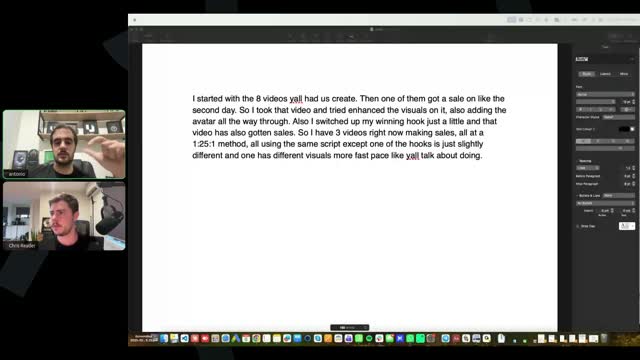
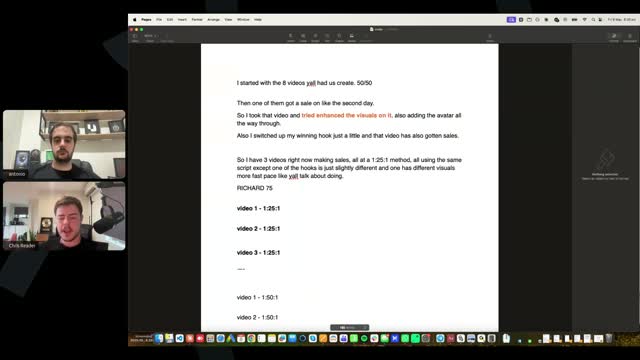
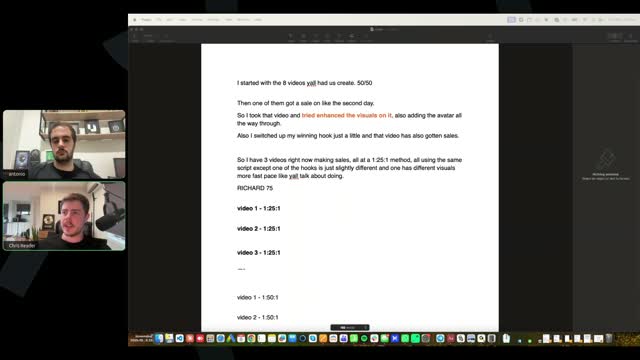
[30:12] [SCREEN 30:12] Chris Reader shares a text document. The text reads: "I started with the 8 videos yall had us create. Then one of them got a sale on like the second day. So I took that video and tried enhanced the visuals on it, also adding the avatar all the way through. Also I switched up my winning hook just a little and that video has also gotten sales. So I have 3 videos right now making sales, all at a 1:25:1 method, all using the same script except one of the hooks is just slightly different and one has different visuals more fast pace like yall talk about doing."
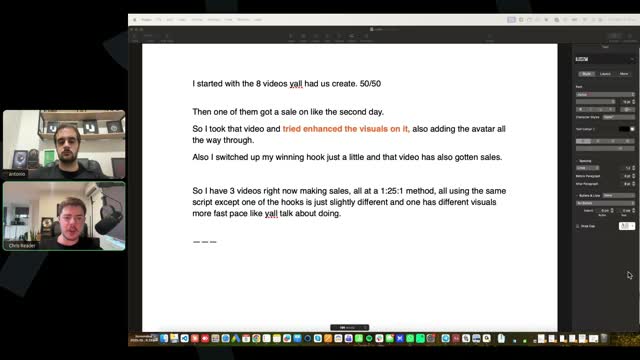
[30:18] Chris Reader: Yeah. So this is what Richard's done so far. So guys, let's take an analyzation, let's analyze this not only for you guys to understand what he may have done, but also so we can help you, Richard, get to more sales. All right. So he said, I started with the eight videos you had us create. Again, the 50/50. So 50% of the ads were the same winning script with just new hooks. 50% were like entirely unique, uh, you know, taking the winning videos and then modeling, modifying them, right?
[30:55] Chris Reader: One of them got a sale on like the second day. So I took the video and tried to enhance the visuals on it, also added the avatar all the way through. Okay. So look, you know, he's probably identified that through our, through these live calls, we're saying to you guys that a lot of the visuals, you know, are not as high quality or really like the winning videos. So he's enhanced the visuals, right? Making sure that there's more, you know, engaging visuals, more realistic visuals, faster paced editing, and again, replicating more like the examples of what we've done. So nice work, Richard.
[31:34] Chris Reader: Then he tested winning, uh, switched up my winning hook just a little bit on that video, uh, has also gotten sales. And so now he says, now I've got three videos making sales, all at 1:25:1 method, all using the same script except one of the hooks is slightly different and one has different visuals. All right. So brilliant. So one thing I would say, Richard, here is it sounds like you've kind of followed the evolution method, but it also sounds like you kind of haven't. So one of the things, it's always going to come down to executing on what we've done.
[32:11] Chris Reader: So even though you've kind of done it, like you say you've enhanced the visuals, which again, it's kind of like, you know, the first evolution, and then you switched up the hook a little, but again, did you test three versions of the hook or did you just do one? Right? So it's really key to, you know, you don't want to get to these positions by luck, guys. You want to get here systematically and every single time. So Richard, what we need to do now is we need to get you following... So firstly, let's just discuss the evolution method because it's very important to understand, again, like you can get here by accident by doing one or two things half right, but we want you guys to know that you need to be doing everything always correctly the same way.
[33:01] Chris Reader: So in this situation, I don't know, Richard, you should just be scaling, especially if you spent like $160 and made like a thousand bucks profit, like ROI. But first, let's just discuss. So guys, again, evolution method, three, you must be testing in batches of three. So first thing you do is test three opening scenes. Then you take the best opening scene, you test three script hooks.
[33:28] Chris Reader: Now one key thing that he's mentioned here, guys, is he used, you know, he's tested a variation of his winning hook. And like we say, guys, you can take a winning hook that's getting sales and you can make slight modifications to it. So make it a little bit more aggressive, make it more angled towards social proof, make it more towards a specific emotion, right? We have an entire training on how you can, you know, add a super hook to it, add the big idea to the hook, right? Like you can take a winning concept of a hook and you can transform that into, you know, five different emotions. And then you can, one of the emotions might convert better and boom, now you've got a winning ad, okay?
[34:14] Chris Reader: So Richard said he only tested three. So real quick, Richard, when you said you would try to enhance visuals, did you do enhance visuals throughout the entire video or you, this is like the opening scene tests? Uh, let us know here when you can, Richard.
[34:38] Antonio: Yeah, Chris, you know how many scripts you guys had as well? You had.
[34:45] Chris Reader: This is, uh, he did eight scripts. He started with, well, he would have started with four scripts. Four scripts and then the two hooks and then one of the hooks was performing. So, but yeah, this is the strategy, right? You, you know, Richard said here he did three opening scenes, but he only did one hook. So, you know, it's, it's still good that you found a winning hook straight away, but again, if you had tested three hooks, maybe you would have found three winning, like three better hooks, right?
[35:17] Chris Reader: So the key is making sure that, you know, even though you've done really well here, Richard, and you've implemented the evolution method like half, half, you still need to follow it every time. So Richard said when he tried to enhance the visuals, this was not the entire script, it was, it was just the opening scene. So brilliant. So look, he found an ad that made a sale. He tested the evolution method by testing the opening scenes. He then also then tested one new hook and, you know, his ad with new visuals performed well and his ad with new hook performed well. So you said you've now got three videos making sales right now.
[35:56] Chris Reader: But again, the key thing is you, you know, you need to follow the evolution method. It sounds like you tested new visuals at this point and then at the same time you tested new hooks. Like you want to test new visuals, find the best opening scene, then test new hooks. Like everything should be branching off so you're automatically optimizing. So this is the biggest key is just following the structure.
[36:20] Chris Reader: But with that in mind, like does that make sense, guys? Like, you know, we don't want to tell you, oh, I need, I should test an opening scene here, but I might also test one hook individually right now, because it's not following like a step-by-step path. And you need to have that step-by-step path because we want to get to success every time. You know, we don't want to just fluke our way because we did one fraction of the process correctly and it worked that one time, you know.
[36:54] Chris Reader: So like right now you said you got three videos. So like, you know, maybe you, you know, like maybe right now you've got like the OG video with new visuals and then you got like the OG video with new hook. And then it sounds like you might even just have the OG video, right? But the reality is like, you should have like the new visuals that are working and then you test the new hooks and it should be like this, you know, like you should have it like that. Because everything builds on top of it. Because if you have a new opening scene that's working really well and then you add that new hook that's working really well, well now you get two times the benefit, you know, rather than just one times, okay?
[37:39] Chris Reader: Someone said, is it like a family tree? Yes, it is like a family tree, exactly. It's called the evolution method because it's literally, yeah, like evolution, you know, like if the, it's literally like that. So every new, like if the new hook works, then you, if the new visual works, then yeah, it has three children. And then if those don't work, that whole family is just, you know, removed from the scenario. But then if another one works, then it has three children. Cool, well now the child that's now performing the best, now you test with three new hooks. So it's literally exactly like that. It's called the evolution method for a reason. So if it helps you to understand it like a family tree, perfect, you know, exactly.
[38:29] Antonio: Yeah, and that's why I like doing something as well that I don't see many people doing yet because it is slightly more advanced and we might be talking a little bit more about this in the more advanced methods and classes. But it's also testing different avatars with your winners. So a lot of the times I like testing like two different avatars with my winners. For example, let's say I have an avatar which is a blonde girl in the kitchen, and then I will test an avatar that it's a whole different avatar concept. So same visuals, same script, right? Same hook, but just changing the avatar, just changing who is speaking. And this is already going to direct your winner to a different pool of people.
[39:06] Antonio: The one thing I do recommend is do it intentionally, right? So I'm not going to change the avatar just to test if the girl is blonde or a redhead. That's not intentional, right? But I do want to test to see, okay, if maybe a blonde young woman in the kitchen or an old woman in her car can attract completely different types of people to that offer, even though the base, so the other variables are the same. So the script, the visuals, the hook, and all that fun stuff. Right? So this is another variable that I think once you find a somewhat profitable ad is really worth testing and evolution scaling as well.
[39:44] Chris Reader: Yeah. And again, that yeah, that is in the evolution method towards the end there as well. And again, one of the other evolution methods, which is like an X mode, which is not like a structured, it's not as structured, but again, it can help you revive winners. It can also just help you give ideas and concepts for new scripts. But like, for example, if you guys have a script that's performing really well, just like Antonio said, you know, if it's a woman sitting on a couch, turn it into like a middle-aged, like if it's an old woman sitting on a couch, change it to like a middle-aged woman speaking on a podcast. Change it to like a doctor talking about it or something like that.
[40:22] Chris Reader: Another thing you can do as well is if you have a script that's really, really good and it's like a recipe script, like more first-person style, you know, the script for example wouldn't really resonate if like a doctor was speaking it or like a nurse or something. But you can get AI to keep the exact concept of why it's working, but just change the way it's said so that it sounds now more like authoritative. So it's like, I used to have people that were doing this, like, you know, so it's still the same exact sort of script, but for example, you know, some first-person story scripts, if a nurse or someone, a medical authority was saying it, like it wouldn't really make sense. But you can twist that exact same ad and just get it to be said by like an authority figure. But it's still got all the key winning things. Now that's obviously more of like a more hybrid test. Um, but again, when you get to a certain point where you have winning ads, you want to do all these little tests because it can unlock completely different styles of ads, okay?
[41:27] Chris Reader: Now, key thing again is just always following the system we have, guys. I cannot say it enough. We don't want you to just randomly fluke something. We want you to get here every time and understand why you got there. Next thing is, all right, Richard, we need to get you scaling up straight away. So you've got three video ads running, all 1:25 method. So by the sounds of that, you would be spending around, you know, well, you've got 3 times 25, so what's that? You're spending, you should be spending like $75 on this right now. But you said you spent 170. Can you clarify like what your structure is so we can get you scaled up? Let us know, Richard.
[42:17] Chris Reader: And then he's also asked this question. So this is a good point. Now guys, for everyone, just listen to what we just said there, following the evolution method. Now we're going to get into some more of the advanced stuff. It's good to understand this, but if you're not at this point yet, don't let it confuse you. Focus on like the next two steps in front of you. Don't focus on 10 steps ahead.
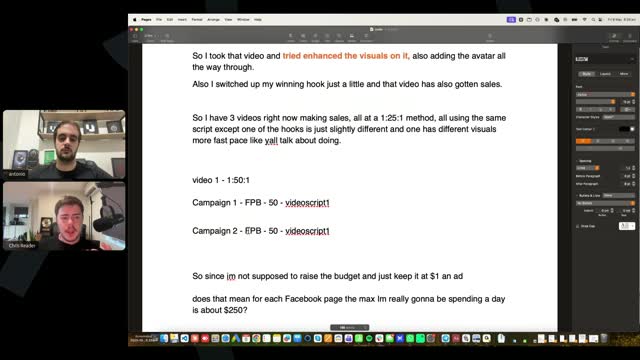
[42:41] Chris Reader: But he also said, since I'm not meant to raise the budget and keep it at $1 an ad, does that mean for each Facebook I can really only be spending around $250?
[42:54] Antonio: For each Facebook page? If using the minimum budget, yes.
[43:00] Chris Reader: Yes. Yeah. So you can only have uh 250 ads per Facebook page, right? And guys, the reason we teach you this strategy, it would be a lot easier for us to teach, like it would be so much easier for us to teach you to just have one ad and spend like $50 on it. But we have been seeing literally like 75% more success in every single campaign that we have set up like this. So we want you guys to have success, even though it might make our life harder trying to teach you this, even though it might make your life a little bit harder trying to set it up. This has literally been outperforming every other structure by far. So even though it's a little bit more complicated, we would rather teach you something a little bit more complicated with way higher success, like way higher ROI, okay?
[43:51] Chris Reader: So yeah, that's like in the course Antonio says, so 250 ads per page is what, so every time you, every time you go over 250 ads, you need to make a new page, right? So Richard, for you, you need to start, if you've got three videos that are making sales right now, this is what I would do, Antonio, let me know, but I would launch, you know, video one, one, honestly 50, one. Or should he just go straight to 100? What do you think, Antonio?
[44:29] Antonio: I mean, the thing is, I show this in the horizontal scaling method where you can keep increasing the duplicates if it's still crushing. The only thing I would say is just wait 48 hours until you do that, or you can go, you can be more aggressive. In your case, I would just go more aggressive because your ROI is insane. Like if we're talking about like 20% ROI, then I'll probably wait two days before scaling every time and see if the ROI holds.
[44:52] Chris Reader: But he's done like 800% ROI yesterday.
[44:55] Antonio: Exactly. Exactly. So in this case, yeah, just, just go for it. I'll probably do 100, one and see if it holds.
[45:01] Chris Reader: 100 or 50?
[45:03] Antonio: Uh, 100. I'll be more aggressive in this case personally.
[45:07] Chris Reader: Yeah. So we got to identify, but then also again, we need to take into account the 250 ads. Now someone just asked a really great question. Is it 250 total ads or active ads? And the answer is active. Active. Active. So the reason in your campaign names, guys, the reason why we, we told you to name it, uh, you know, campaign one, one, we told you to have like the campaign, what you're testing, for example, script one, hook one, opening scene one. Then we told you to have the, the Facebook page and then the number of ads, is because then you can easily just look at what you're running.
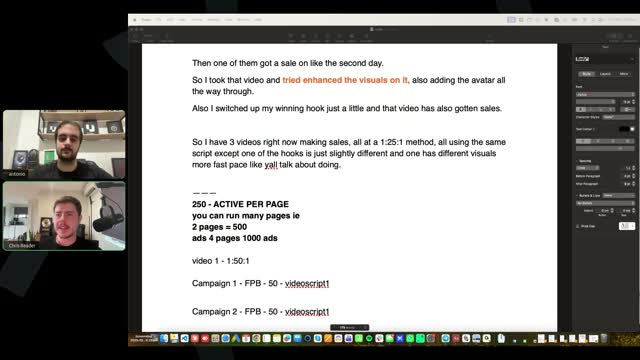
[45:49] Chris Reader: So if, if you're running, like in this case, you know, Richard will be able to see he's running three campaigns, right? And you can just, he will, he will have 25 in each campaign name. So now he knows that he's running 75 ads. So he can then see, all right, how many more ads do I have that I can, you know, scale out to that point, right? So that's the reason in the page naming conventions, we told you guys to put, sorry, in the campaign, we told you guys to put like the page acronym and then what the structure is, because if you don't have that, then you're going to have to like go into every single campaign, understand, all right, what page is this running on, how many ads are in it, now I have to do calculations. Whereas like, you know, in the future you could just have like campaign one, you've got your like Facebook page here, and then you've got like 50, and then you've obviously got like video script one, whatever. And then if you've got another one, well now you can immediately see, all right, this page has got 100 active ads. So I can do 150 more, you know? So that's the reason why we put that in the page name.
[47:01] Chris Reader: Someone said, are all 50 duped ads counted as new ads? Yes, active ads. So every duped ad is an ad. So again, just like I said, this 1:25 structure, guys, if you only have one of these campaigns, you have 25 active ads. All right. If you have two of these campaigns, you've got 25 times two, so you got 50 active ads. All right.
[47:26] Antonio: And by the way, guys, it's going to, don't, don't get scared of this. You can just duplicate it and once you hit the limit, Facebook's going to tell you. Like it's just not going to run, literally. So you don't need to be counting that all the time. But that's why also like every 10ish days, I'm always proactively creating a new page, okay? Then because you also have a few days to just warm it up. So you're just not immediately creating a page and running ads next day. So ideally I always like warming up a page for at least two or three days. You know what I mean? So that's why I'm always proactively creating new pages. Um, I think that's just better. That's just more proactive.
[48:01] Chris Reader: Yeah. Yeah. So because it's better to sort of, yeah. So like, you know, you should create campaigns, uh, sorry, pages every now and then. Now guys, someone's now, someone was saying, yes, so we can run 500 ads on two pages in the same ad account? Yes. So you can run many, many pages in the same ad account. So for example, like, you know, if you have two pages, you could have 500 ads. If you have four pages, you could have a thousand ads, right?
[48:29] Chris Reader: So this, and again, this might sound complicated and stuff, guys, but like, you know, this is the strategy that is absolutely killing it right now. So yeah, we could have taught you a simpler method, but like this is literally getting like way better results, like five times more likely to have success with this strategy than just the regular sort of strategy out there. All right.
[48:56] Chris Reader: So guys, someone, people are saying with digital solutions, how do I make pages? Guys, in digital solutions, if you don't have digital solutions, do not worry. But if you do, make the pages at the profile level. So you can make Facebook pages in digital solutions at the profile level. So you can make as many pages as you want at the profile level. I've asked them, I know the owner, he said it's fine, but you make them at the profile level, okay? Okay. All right.
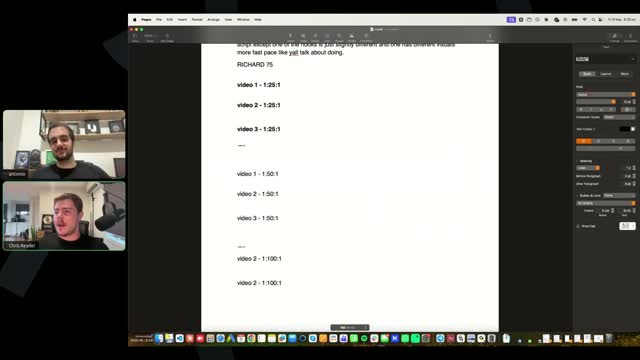
[49:29] Chris Reader: So, um, all right. So Richard, let's just do real quick. You've got three campaigns, 25, so you got 75 ads running. So let's just do calculator. 250 minus 75, uh, 100, you got 175 ads left that you can run. So that's why I would recommend doing, I would recommend doing 1:50 and I would recommend doing video two, video three. This is what I would recommend you doing.
[50:00] Chris Reader: This is what I would recommend you doing. And just immediately scale up. Now you're immediately scaling your budget up by $150. Now, do not delete the current campaigns you have. Keep the current campaigns you have. But add this. So now you're adding an extra $150 to your page, to your account, okay? All right. Yes, any thoughts on that, Antonio?

[SCREEN 50:00] A text document is shown on screen. Chris is typing in it. The text reads:
RICHARD 75
Video 1 - 1:50:1
Video 2 - 1:50:1
Video 3 - 1:50:1

[50:30] Antonio: No, I agree, honestly.

[50:33] Chris Reader: Yeah. And then in the meantime, Richard, you know, make another page, make another two pages. And then on the next page you create, you know, you could, on the next page you create, you could do whatever video is performing the best, right? You could then do this. Right? Launch it at 100. Okay? And then you could, you know, and then you've got 50 ads spare left if you want to use them. But again, do this and then whatever's working the best, then you just do even more. And now you've just added another $200 to your thing. And also something that Antonio is really big on as well is like spotting patterns because guys, as you do this, you might identify that you're having more success with 25 ads. Like, you know, so what Richard will eventually have is right now he's got this. Let's just do this real quick. All right.

[SCREEN 51:30] Chris copies and pastes a block of text in the document. The new text reads:
Video 1 - 1:25:1
Video 2 - 1:25:1
Video 3 - 1:25:1

[51:37] Chris Reader: All right, so what Richard has right now is this. What he's going to do is this. Right? And then once he finds more clarity on exactly what's winning, you could then again scale up that individual best one.

[51:54] Antonio: And I also like thinking as well, okay, what if you go to 1:50:1, so second stage, and it doesn't work for most of them? Then in that case, instead of already trying to go to 1:50:1, I would try duplicating multiple 1:25:1. Because even the structure is a variable that you're testing. So it is possible that you go to 1:50:1, you try twice, it doesn't work. Cool. So let me try duplicating at the campaign level, having multiple 1:25:1 per winning video versus having a 1:50:1 or 1:100:1. So that's another scaling technique that I show in the horizontal scaling class as well. You can either scale at the ad set level, just duplicating more, or you can scale at the campaign level, just duplicating that campaign as well.

[52:36] Chris Reader: So someone asked what, you know, they're confused about why we're saying 25 ads. So guys, just to clarify, each structure that I've got on the screen right here is a campaign. Okay? Every campaign should have one ad creative. So in this, it's got video 3. Whatever that is for you, whatever the creative is. So maybe it's a different hook, whatever, right? Then this 25 is ad like duplicates of that ad. But they're also called, they're like ads, right? Because this is the campaign, this is the ad creative for that campaign, but then this level here is like the ad sets. But that's why we're saying like 25 ad sets, okay? All right? So yes, this is what I would do if I was you, Richard. And again, what you could also do is like, let's say you guys are at this point here where you've got, you know, this would be a new page, okay? So this would all be one page because it's, you know, you're within the threshold. Then you can make a new page to do one 1:100:1. But then you've got 25 ads left. So what you could do is you could use, sorry, you got 50 ads left on that page. You could do 25, you could do two 1:25:1s and just test, you know, a new variation, like a new hook or something. New hook, like hook 3, hook 4 or something, right? So use all the extra ads that you have in your, you know, because especially if you're doing 100s, you're always going to have 50 left. So use it to create like two variations, to to, you know, this could be hooks, maybe it's even an avatar test. It's just something in the evolution method that you're at.

[SCREEN 53:50] Chris types more text into the document:
Video 2 - 1:100:1
1:25:1 - hook 3
1:25:1 - hook 4

[54:27] Chris Reader: All right? But guys, one thing I will say is always structure your stuff like this. And I say this in every single training of mine, you guys should already know this, but write out what you're doing and what you're going to do. Because it's so complicated if you're just sitting there thinking, oh, I've got video 1, 2, 3, 1:25, 1:25, and you can't visually see it. But once you visually see it, you can see how simple it is. It's literally just like Lego blocks, you know what I mean? It's just, this is, it's just simplified once it's written out.

[55:03] Antonio: And at the end of the day, it's just variables. Like each of these things you're testing is a variable. So the structure, 1:25:1, 1:50:1, 1:100:1 is a variable. Like once you have profitable ads like Richard, one thing that some people try as well is just, hey, doing 1:1:1 even and try to scale it. But once again, we don't recommend this because we've seen this ad set strategy with the minimum budget just does better on average, right? So that's what we recommend. But you can even test different structures as well once you have a winning script at least, ideally two or more, right? But we're not covering all that because Richard already has winning scripts, right? So that's why he can do this.

[55:44] Chris Reader: Yeah. But this is the structure, this is the scaling structure just, you know, written out. So guys, key things is again, remember, follow the training. Also like another point as well, someone in the chat said, oh, we got to jump off here in a bit guys, right, pretty soon. So this will be like the last thing we discuss here. But someone in the chat said, oh, my ad spent, you know, like $200 or something, it had two engagements. Oh no, they said it spent like 175 and it had two engagements, but no sales. And again, guys, you turn your ads off if they have over, you know, $50 CPE, right? So, you know, you need to make sure you're following that testing protocol. You know, even Antonio's been, was telling me that on a lot of the Looms, you know, you guys are not following the testing protocol, right? Like your ClickMagick shows that you've got two engagements at, you know, $65, no sales. And again, the testing protocol says turn the ad off if the cost per engagement is over $50, right?

[56:53] Chris Reader: Um, okay, so final question here. Someone said that they're experiencing an issue where their videos are not appearing in their catalog ad even though they upload them correctly. He said he's watched the full training videos for the setup and the troubleshooting the catalog bugs. Once I notice the video is missing in the catalog, I click edit and see that there is no video. And even the website links are missing. No matter how many times I try editing it, it does not work. This was an error that does not show up in... I see this error notification saying that this product could not be updated due to a system error. This error has not appeared in Antonio's video. Yes, the video, the error is not in Antonio's video because we could not replicate the error, right? So Antonio was teaching you guys how to identify if this is happening. And I also mentioned this earlier, it is happening to some people, right? So we don't know what, it's clearly an error on Facebook's side because it literally tells you it's like an error. The one thing we would say is instead of editing it, just make a new one, right? Like one of our other YouTube mentors was having the same issue and he said that like he would create four catalog ads and four of them would, two of them would work. And then he would just have to, you know, just have to keep remaking them. So for some reason, we're not sure why this is happening. I've never seen this issue with catalog. And you know, even when we're trying to replicate it, that's why Antonio's video didn't show the error because we couldn't replicate it. But instead of editing the catalog ad, make a new one, right? Sometimes also we believe that it's maybe like a Facebook internet issue or something and it's showing that error and then if you come back like 15 minutes later, it won't have the error.

[58:48] Antonio: But I think one pattern I've seen is that it has been easier to just recreate one from scratch than editing the catalog. Like editing the catalog just has been super buggy, literally. And by the way guys, it is a skill to be resourceful as well, which I think is important because I've tried mapping out literally every error. A lot of them I just can't replicate on my end because I don't get them, right? So statistically speaking, we're always going to be getting new errors and then obviously just sharing this information with us here, with our support, and we're always going to be here to help. But also be resourceful. A lot of the times if you just keep recreating from scratch, testing new ad accounts, you're able to solve it. So this helps quite a ton as well.

[SCREEN 59:24] Chris switches to a PDF document titled "Million Dollar Testing Protocol". It displays the following text:
Target KPIs
CPC (Cost Per Click): $1.50 - $2.00 USD
CPE (Cost Per Engagement): < $50 USD
CPA (Cost Per Acquisition): $150 - $170 EUR / $150 - $170 USD
Testing Stages
Level 1: CPC Check - @ $15-$20 Spend
Level 2: Engagement Check - @ $50 Spend
Level 3: Sale Check - @ 1x CPA ($170 USD)

[59:35] Chris Reader: Yeah. Brilliant. All right. So guys, just, you know, this is like your Bible, okay? This is your Bible and the evolution method is your Bible, okay? You need to follow everything in the evolution method perfectly. Again, we see consistently that some people might do one element of it right, but again, you need to do, you need to do it always the same strategy, okay? Because it's literally, you know, you make it so much harder for yourself if you do not follow the evolution method because then you don't know what to do or when to do it. The evolution method makes everything that much simpler, okay? All right. But guys, that's it for this session. This has been a really, really valuable session, I think. So guys, next week, we'll jump into some more ad reviews, we'll jump into script writing. And ideally guys, the strategy is we want to be doing these sort of calls where we're talking about ad strategy, scaling strategy, like evolution. It's always going to be the same thing. It's like scale up your ads like this and then testing new hooks, testing new opening scenes. And that's the structure that we're going to be following through guys. All right? So another thing is someone said my entire campaign is only spending $2 per day. How do I fix it? Guys, just bump your ad spend up 10 to 20%, like bump it 10% across every ad. If your ads aren't spending...

[1:01:06] Antonio: No, I was just going to say that FYI, the last person that was having this issue just forgot to duplicate the ads at the ad set level. So check if you actually have 25 ad sets with 25 ads, each with $1 budget. That's the first thing. But then exactly what Chris is going to say.

[1:01:21] Chris Reader: Yeah, yeah, yeah. So if your engagement campaigns aren't spending, your ads aren't spending, bump all the ad set budgets by 10%. Okay. All right guys. And someone said, thanks guys, it's starting to make more and more sense. Yeah, you know, you're learning something new. So even though we're, you know, our goal is to push you guys to success. So we want to, we want to be harsh where we need to be harsh because that's what I'm sure you guys want, you know, we want to get you guys all making money. But obviously, you know, don't be too hard on yourself. We're there to be like that, you know, we're like your personal trainers. We're going to push you in the gym. We're going to push you to focus on what matters. We're going to push you to make sure you're doing everything correctly, okay? That's like the goal of what you've joined here for, so that we can all make a ton of money and you guys can make money. And it's all just about really coming back to the training and making sure you're following it. All right? That is the biggest key. All right, guys, that's all. See you guys all on Monday. All right, bye everyone.

[1:02:22] Antonio: See you guys.
Call 09 of 13, recording 09-May 07 2026.mp4. Gemini video pass at one frame every 2 s. Rebuilt 31 Oct 2026 15:24 Melbourne.